Posting at the right time can increase your LinkedIn engagement by 2-3x. But "right time" isn't universal, it depends on your audience's timezone and industry. This guide breaks down optimal posting times by region, and shows you how Klyo now finds your best time automatically.
Klyo's Content Calendar includes a built-in Best Time to Post recommendation, based on your own published posts once you have enough history (or a proven starting point before that), so you don't have to manually cross-reference tables like the ones below.
Why Timezone Matters (The Real Problem)
LinkedIn's algorithm distributes your post to followers who are active in their moment, not your moment. Post at 10 AM EST? Your Tokyo followers won't see it immediately if they're asleep.
LinkedIn prioritizes posts to users active at publish time. If you post during PST morning hours (6 AM) but your audience is mostly EST, you're publishing to sleeping people. By the time EST wakes up, your post is 3+ hours old and gets lower algorithmic ranking.
Solution: Schedule posts for your audience's timezone peak hours, not your own timezone.
Optimal LinkedIn Posting Times by US Timezone
| Timezone | Best Times | Avoid |
|---|---|---|
| EST (New York, Toronto) | 8-10 AM, 12-1 PM, 3-5 PM | Before 7 AM, after 7 PM |
| CST (Chicago, Mexico City) | 7-9 AM, 11 AM-12 PM, 2-4 PM | Before 6 AM, after 6 PM |
| PST (Los Angeles, Seattle) | 6-8 AM, 11 AM-12 PM, 1-3 PM | Before 5 AM, after 5 PM |
Optimal Posting Times by Global Timezone
| Region | Timezone | Best Times |
|---|---|---|
| Europe (London) | GMT/UTC | 12-2 PM, 5-7 PM |
| Europe (Paris, Berlin) | CET/CEST | 1-3 PM, 6-8 PM |
| India | IST | 5:30-7:30 PM, 9-11 AM (next day) |
| Japan | JST | 9-11 PM, 3-5 PM (next day) |
| Australia | AEST | 10 PM-12 AM, 4-6 PM (next day) |
Best Day to Post on LinkedIn: Day-by-Day Breakdown
Timezone tells you which hour to publish. Day of week tells you which day is worth spending a post on at all. Midweek consistently outperforms the edges of the week, but every day has a usable window once you know where it is.
| Day | Best Time | Engagement Level |
|---|---|---|
| Monday | 10 AM - 12 PM | Medium |
| Tuesday | 8-10 AM | High |
| Wednesday | 8-10 AM, 12-1 PM | Highest |
| Thursday | 8-10 AM, 1-3 PM | High |
| Friday | 8-11 AM | Medium |
| Saturday | 9-11 AM | Low |
| Sunday | 6-8 PM | Low to medium |
The short answer: Wednesday 8-10 AM is the strongest single slot of the week, and Tuesday through Thursday mornings are the most reliable block overall. Weekend engagement drops roughly 40% against weekdays.
Best Time to Post on LinkedIn on Monday
Monday mornings are the worst slot in the week. Your audience is clearing a weekend backlog and your post competes with every unread email. Wait until the inbox rush settles and publish between 10 AM and 12 PM. Monday works well for planning and goal-setting content, because that is the headspace people are already in.
Best Time to Post on LinkedIn on Tuesday
Tuesday is the most reliable day on LinkedIn. People are settled into the week but not yet buried. The 8-10 AM window catches the commute and the first working hour. If you only publish once a week, publish Tuesday morning.
Best Time to Post on LinkedIn on Wednesday
Wednesday consistently produces the highest engagement of any day. You get two usable windows: the 8-10 AM start of day, and a secondary 12-1 PM lunch peak that most other days do not have. Save your strongest post of the week for Wednesday morning.
Best Time to Post on LinkedIn on Thursday
Thursday performs nearly as well as Wednesday and has a distinctly stronger afternoon than the rest of the week. The 1-3 PM window is worth using for longer-form posts, because people are more willing to read at length before the week winds down.
Best Time to Post on LinkedIn on Friday
Friday engagement is front-loaded. The morning still performs, but attention falls off sharply after lunch and keeps dropping into the evening. Publish before 11 AM or wait until Monday. Friday suits lighter, more personal posts than a technical deep dive.
Best Time to Post on LinkedIn on Saturday
Saturday has the lowest total traffic of the week, but it also has the least competition. A Saturday morning post reaches a smaller audience with far fewer rivals in the feed, which can work in your favour on a niche topic. Treat it as a bonus slot, not a primary one.
Best Time to Post on LinkedIn on Sunday
Sunday evening is the one weekend slot genuinely worth using. People start mentally preparing for the week ahead and open LinkedIn to see what they missed. Engagement between 6 and 8 PM beats most of Saturday and all of Sunday morning.
Best Time to Post on LinkedIn by Country
Posting times shift with working culture, not just clock offset. These are the peak windows for the main English-speaking and Western European markets, in local time.
Best Time to Post on LinkedIn in United Kingdom
Peak windows: 12-2 PM, 5-7 PM GMT. The same windows apply to Ireland. UK engagement peaks over lunch and again on the evening commute. Midday outperforms the early morning here, which is the opposite of the US pattern, so do not copy an American posting schedule onto a UK audience.
Best Time to Post on LinkedIn in Canada
Peak windows: 8-10 AM, 3-5 PM EST. Canadian audiences track closely to US Eastern patterns, so if your audience spans Toronto and New York a single EST-aligned schedule covers both. Vancouver sits on PST and runs three hours behind, which matters if a meaningful share of your network is on the west coast.
Best Time to Post on LinkedIn in Europe (CET: Germany, France, Netherlands, Austria, Switzerland, Sweden, Norway)
Peak windows: 8-10 AM, 12-2 PM CET. Continental European workdays start earlier than the UK, so the morning window opens sooner and closes sooner. German, Dutch and Nordic audiences are reliably active from 8 AM; French engagement skews about an hour later. The Nordics finish earlier than the rest of the continent, so late-afternoon posting underperforms in Sweden and Norway compared with Germany or France.
One post on a CET schedule serves all seven of these markets, because they share the same clock. The split that actually costs you reach is CET against US Eastern, which is six to nine hours apart.
Best Time to Post on LinkedIn in India
Peak windows: 9-11 AM, 5:30-7:30 PM IST. India has two strong, clearly separated windows. The morning slot catches the start of the workday, and the 5:30-7:30 PM slot catches the commute home, which is the single highest-engagement period for IST audiences.
Best Time to Post on LinkedIn in Australia
Peak windows: 8-10 AM, 4-6 PM AEST. Australian engagement follows a conventional workday curve. The complication is cross-posting: if your audience is split between Australia and the US, those two peaks fall almost exactly opposite each other, so one post cannot serve both well.
Best Posting Times by Industry
Industry affects when your audience is most active on LinkedIn:
- Tech/Startups: 9-11 AM (morning standup time, high engagement)
- Finance: 8-10 AM (market open, professionals checking news)
- Sales/B2B: 9-10 AM (prospect outreach peak)
- HR/Recruiting: 9-11 AM or 1-3 PM (hiring reviews)
- Marketing: 10 AM-12 PM (content planning hours)
How to Schedule Posts Across Multiple Timezones
- Identify your top 3 geographic markets using LinkedIn Analytics (Settings → Analytics → Visitor Demographics)
- Note their timezones (e.g., 40% USA EST, 30% EU GMT, 20% Asia IST)
- Schedule the same post for each timezone's peak (e.g., 10 AM EST, 4 PM GMT, 5:30 PM IST)
- Track engagement by region in LinkedIn Analytics to see which timezone performs best
- Adjust future posts to prioritize high-engagement timezones
Generate 4 Weeks of Optimized Posts with Klyo
Klyo's Content Planner generates 4 weeks of LinkedIn posts in a single click, with voice-trained content that matches your brand. Then use Content Calendar to schedule them across timezones automatically with auto-posting enabled.
Try Content Planner FreeHow Klyo Finds Your Best Time to Post (Not Just an Industry Average)
The tables above are solid starting points, backed by broad LinkedIn posting times research. But "the average LinkedIn user" isn't your audience. Klyo's Content Calendar now includes a built-in best time to post feature that replaces those general benchmarks with your own numbers, the moment you have enough posting history for them to mean something.
Here's exactly how it works, step by step:
- It reads your published posts. Once you've published at least 3 posts through Klyo, it pulls their real engagement, reactions, comments, reposts, directly from LinkedIn.
- It groups them by day and time of day. Every post gets sorted into a day of the week and a 4-hour window, so the pattern isn't just "which day" but "which part of that day."
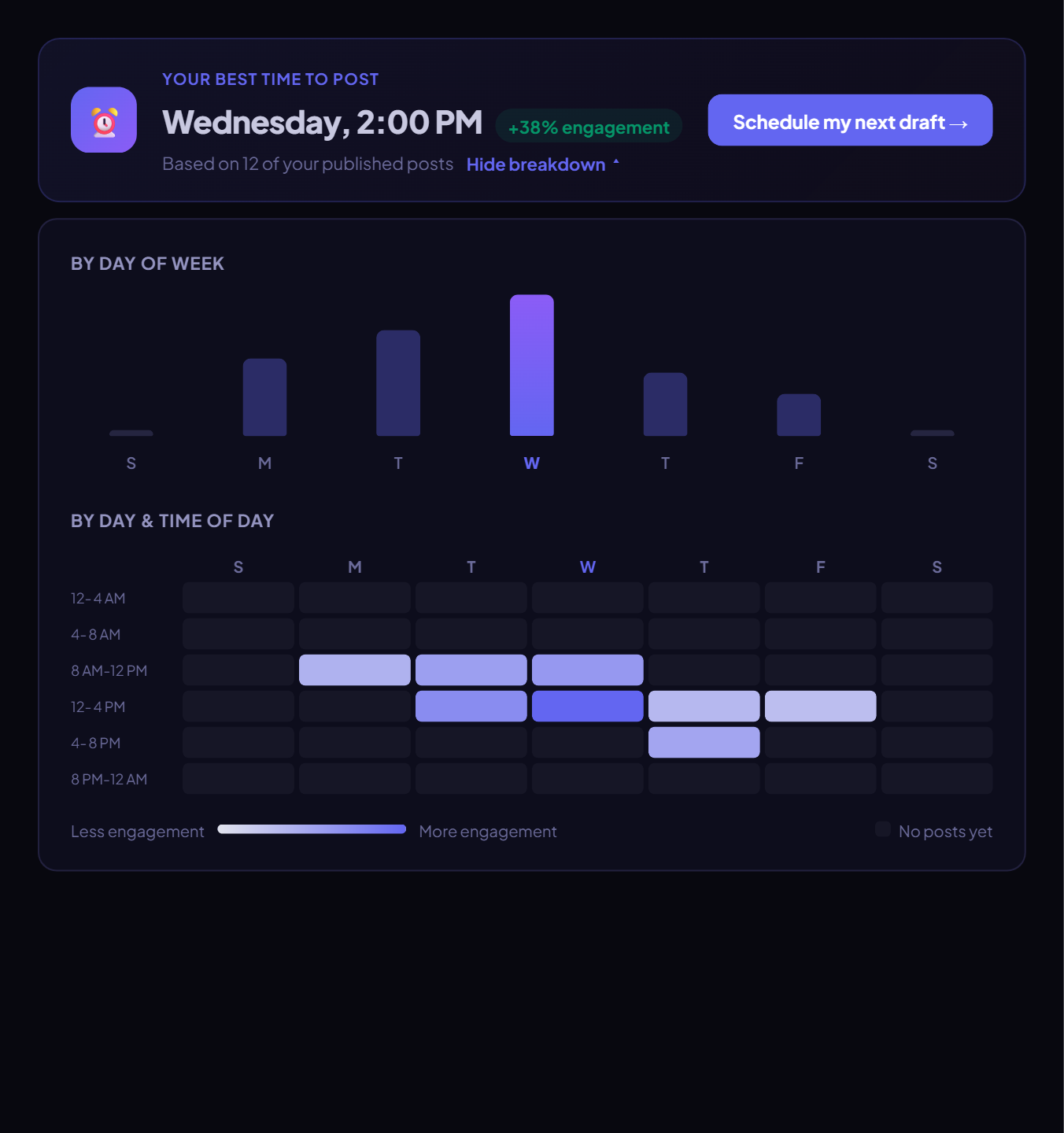
- It finds your personal peak. Klyo compares average engagement across every day and time window in your history, then surfaces the single best combination, for example "Wednesday, 2:00 PM," specific to your account, not a generic best days to post on LinkedIn chart.
- It shows the full breakdown, not just one answer. A day-of-week bar chart and a full posting-times heatmap sit right below the headline recommendation, scaled to your own best result, so you can see your second and third-best windows too.
- New accounts still get a real answer. Before you've published 3 posts, Klyo shows a proven starting recommendation instead of an empty screen.
It's the same idea behind the public linkedin post analytics research that Buffer and Sprout Social publish, applied to your own account instead of an aggregate of millions of posts, and it lives directly inside Content Calendar next to your posting schedule. No separate linkedin analytics tool or spreadsheet required.
Klyo's Content Calendar: Schedule Once, Post Across Timezones
Problem solved: Manually scheduling 12-20 posts across 3 timezones is tedious. Klyo's Content Calendar automates this:
- Content Planner: Generate 4 weeks of LinkedIn posts in one click with AI (voice-trained to your style)
- Content Calendar: Drag-and-drop scheduling for all 4 weeks of posts at a glance
- Best Time to Post: Klyo recommends the exact day and hour to post, based on your own published posts once you have enough history, or a proven starting recommendation before that
- Auto-posting: Posts publish automatically at scheduled times (no manual publishing needed)
- Timezone support: Schedule the same post for multiple timezones in one action
- Analytics view: See which posts perform best by timezone and time
Instead of 3 hours planning + 1 hour manual posting = 4 hours/week, Klyo cuts it to 15 minutes with Content Planner + Calendar + auto-posting.
Pro Tips for Timezone-Based Posting
- Post during commute times: 8-10 AM is peak LinkedIn usage globally (morning commute to work)
- Don't post during lunch: 11 AM-2 PM sees lower engagement (people eating, away from desk)
- Post Tuesday-Thursday: Weekend engagement drops 40% compared to weekdays
- Avoid Monday morning: Information overload from weekend. Monday 3-5 PM performs better.
- Test and adjust: Use LinkedIn Analytics to track which posting times in your timezone actually perform best